EC
Auto-Replenish Shuttle Ecoloveyor GTP (No-walk Picking) Multishuttle System Spiralveyor Storage Systems Super Pick Director(SPD®)Ⅲ
Oisix ra daichi Inc. (ORD Atsugi Frozen Station / Logistics System)
Challenges
- Rapid growth in logistics volume made an expansion in the workforce to support greater operations unsustainable.
- Increasing dependence on individual worker skills resulted in variability in quality and speed.
- Heavy physical burden on workers operating in a frozen environment.
Results
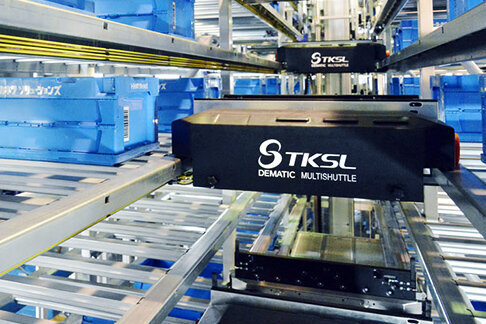
- Introduced an Automated Storage and Retrieval Systems (SAS and Multishuttle® System) to automate storage and conveyance.
- Separated picking methods for high-frequency and low-frequency SKUs to achieve both labor savings and efficiency.
- Fully automated frozen shelf replenishment to significantly reduce worker burden in frozen environments.
- Improved shipping productivity through automatic transfer from tote containers to shipping cartons and automated packing.
- Established skill-independent operations, improving work visibility and planning accuracy.

BackgroundLeading-Edge Frozen Logistics That Tripled Productivity Through Labor-Saving and Automation
Background
Leading-Edge Frozen Logistics That Tripled Productivity Through Labor-Saving and Automation
In January 2024, Oisix ra daichi Inc., a provider of subscription-based food services, opened a dedicated frozen logistics hub, the 'ORD Atsugi Frozen Station.' The facility handles approximately 700 SKUs of frozen products for the Oisix EC grocery service.
Demand for frozen products in households has increased significantly in recent years, resulting in a sharp rise in logistics volume. The previous frozen center relied heavily on manual operations, requiring additional personnel as shipment volumes increased. However, this approach reached its limits, with productivity fluctuating depending on operator skill levels. On site, there was a clear need to move away from the mindset of just increasing headcount to solve problems.
To address these issues, a comprehensive material handling solution was implemented, automating core operations from picking through packing.

Operations and System OverviewAt the Forefront of Frozen Logistics Achieving Threefold Productivity Through Labor-Saving Measures and Automation
Operations and System Overview
At the Forefront of Frozen Logistics Achieving Threefold Productivity Through Labor-Saving Measures and Automation
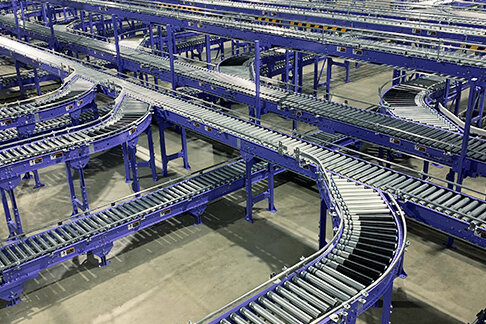
This center consolidates its shipping functions by locating the receiving and shipping area on the first floor, with the picking lines and packing lines arranged separately to the left and right at the rear of the floor. The third and fourth floors serve as inventory storage areas. Utilizing two types of automated warehouse systems installed on the third floor, products are transported to the first floor at the optimal timing to support efficient outbound operations.
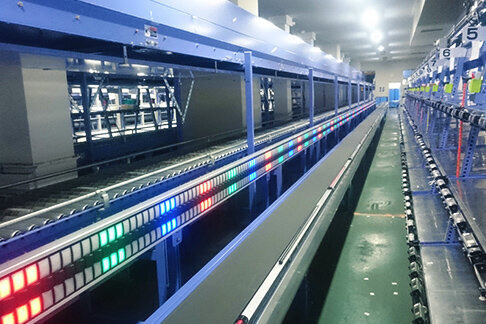
Inbound frozen goods are inspected at the first floor receiving dock and temporarily stored in a −20°C freezer. The picking line utilizes the SPD® System (Super Pick Director), where operators place picked items into circulating totes. Shelving for high-frequency items consists of frozen flow racks installed behind the operators, while low-frequency items are stored in frozen showcases. Replenishment to both types of shelving is carried out on the previous day to ensure smooth picking operations.
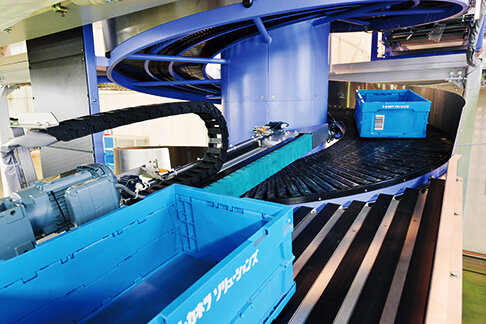
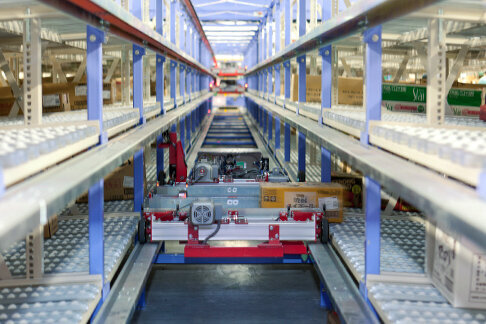
High-frequency items are prepared in advance to facilitate efficient picking. The top surfaces of the corrugated cartons are pre-cut, and after barcode scanning, the items are conveyed to the automated warehouse system, SAS, for temporary storage. After operations conclude in the evening, and as the replenishment shelves approach depletion, shuttles and lifters within the SAS operate at high speed to retrieve the next day’s required inventory from the third floor. For inter-floor transfer, a Spiral-veyor—capable of vertical conveyance even within limited space—is utilized to transport goods to the first floor. From there, items are automatically replenished into the frozen flow racks from the rear side.
Products are sequentially replenished to designated locations by replenishment shuttles. Through this automation of tasks that previously required several hours of manual work in a frozen environment, the center has successfully achieved significant labor savings and a substantial reduction in operator workload.
Meanwhile, replenishment of low-frequency items is also carried out on the previous day. Products temporarily stored in the automated case storage system, the Multishuttle System, are first retrieved and then automatically conveyed to the walk-less picking system, GTP (Goods-to-Person). Because low-frequency items have relatively small daily shipping volumes, quantities are adjusted by sorting them into plastic collapsible containers (oricons). At the GTP stations, work instructions are displayed on the screen, enabling operators to perform tasks accurately by simply following the on-screen guidance, regardless of experience level. In the evening, after the picking lines have stopped, the products are transported to the frozen showcases. By effectively utilizing the remaining time, replenishment is completed within a short period.
For low-frequency item picking, frozen showcase units are utilized to increase the number of locations per zone. By assigning multiple zones to a single operator, the center has achieved efficient operations with fewer personnel. Through the progressive implementation of automation, combined with optimized workforce allocation and task assignment, the center has realized lean, waste-free operations.
Previously, operations were entirely manual, resulting in variations in working time depending on the skill level of individual operators. When highly skilled workers were available, tasks were completed quickly; however, in their absence, processing times increased significantly. According to the representative from Oisix, “By implementing Toyo Kanetsu’s system, productivity has become stable, enabling us to develop highly accurate operational plans—such as estimating how many hours are required to process a given shipment volume.”
The packing area is divided into three zones based on carton size. For the 60 and 80 size cartons—which account for approximately 90% of shipments—an automated packing system is utilized. Shipping cartons are first automatically built. Next, four product totes and four empty shipping cartons are conveyed simultaneously to the automatic transfer unit. The totes are designed without a bottom plate; by sliding them over the top of the shipping cartons, the products are automatically transferred into the cartons. After the transfer process, images of both the shipping cartons and the tote boxes are captured by a vision system, and the system automatically verifies that the totes are empty to prevent any omissions. Dry ice is then added, and the cartons are automatically sealed. For 100-size cartons or products with irregular shapes, items are diverted to a separate line where packing is performed manually.
Completed shipments are sorted by destination, loaded onto roll carts, temporarily stored in a pre-cooling freezer, and then dispatched nationwide.

Customer FeedbackOne Year After Implementation: Stable Operation and Investment Impact of the Frozen Distribution Center
Customer Feedback
One Year After Implementation: Stable Operation and Investment Impact of the Frozen Distribution Center
The new system has been in operation for approximately one year. Even when an excellent system is introduced, it will not yield real value unless it is successfully embedded into daily operations. We sincerely appreciate the comprehensive support provided—from system design aligned with operational requirements, to pre-acceptance testing, and through to final implementation on the operational floor. The strength of the support framework has been invaluable.
In the case of a frozen distribution center, substantial capital investment is required. To ensure a successful return on investment, we needed to establish ambitious labor-saving targets. The performance figures proposed this time were fully sufficient from a ROI perspective. Looking back six months to one year after implementation, the fact that we are achieving the planned targets has made this investment highly meaningful for us.
Going forward, we will continue to expand our lineup of frozen products that households across Japan can use with confidence.
At Toyo Kanetsu, we will continue to support Oisix’s services—and the joy they bring to dining tables across Japan—through the stable operation of advanced material handling systems.
*This article reflects information as of January 2025.
Products and Services Introduced