Retail/Wholesale
Automated Storage and Retrieval System Ecoloveyor Multishuttle System Pallet V-Posi-Sorter
Halows Co., Ltd. (Sakaide Logistics Center / Logistics System)
Challenges
- Product supply was divided among three separate facilities (ambient, chilled, and frozen), resulting in inefficient operations.
- Logistics costs were increasing due to expressway tolls, including the Seto Ohashi Bridge.
- Existing logistics centers lacked sufficient supply capacity to support future store expansion.
- Labor shortages and rising personnel costs posed long-term operational challenges.
Results
- Established a logistics center capable of handling three temperature zones (ambient, chilled, and frozen), improving efficiency and reducing logistics costs.
- Implemented large-scale automation systems including a Multishuttle and Automated Storage and Retrieval Systems (ASRS), achieving significant labor savings.
- Integrated logistics systems to support 24-hour operations and future store expansion.

BackgroundImproving Capacity and Efficiency with a New Three-Temperature-Zone Facility
Background
Improving Capacity and Efficiency with a New Three-Temperature-Zone Facility
In 2023, Halows Co., Ltd. opened the Sakaide Logistics Center in Sakaide City, Kagawa Prefecture. Operating 24-hour supermarkets across the Chugoku, Shikoku, and Kinki regions, Halows required a stronger logistics infrastructure to support continued store expansion.
Previously, ambient, chilled, and frozen products were supplied from three separate distribution centers. This structure increased logistics costs—particularly due to expressway tolls including the Seto Ohashi Bridge—and posed future supply capacity limitations.
To address these challenges, Halows established the industry’s first self-operated logistics center capable of handling three temperature zones. The Sakaide Logistics Center was designed to achieve highly efficient operations and superior productivity.

Efficient Logistics Operations Supported by Automation and Unmanned Systems
Efficient Logistics Operations Supported by Automation and Unmanned Systems
The Sakaide Logistics Center has a total floor area of approximately 28,000 m² and integrates automated equipment across ambient, chilled, and frozen zones.
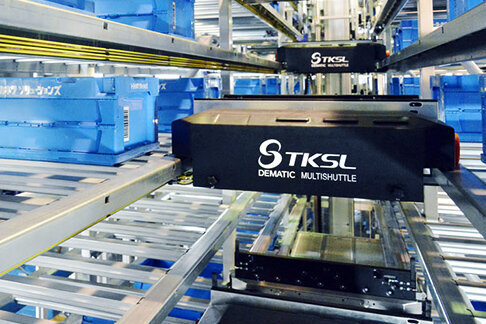
The ambient zone primarily handles case products such as beverages and confectionery. The first floor features a case receiving line, case shipping sortation system, and pallet racks. The second floor houses the core systems: a Multishuttle System and a case ASRS. Processes from receiving to shipping are fully automated, enabling unmanned operation.
Products delivered from manufacturers are placed on the receiving line where an auto labeler applies receiving labels automatically. Cases are then conveyed to the second-floor case ASRS for storage. The warehouse consists of 10 aisles with 10 stacker cranes and can store up to 54,950 cases.
For shipping preparation, required cases retrieved from the ASRS are labeled for their destination stores and temporarily stored in the Multishuttle for order consolidation. Prior to storage, labels are verified and case dimensions are measured; only inspected cases are accepted into storage. Any nonconforming cases are routed back to the first floor via a separate line.
This Multishuttle System consists of three aisles and provides storage capacity for up to 6,384 cases. A tandem layout enables simultaneous inbound and outbound operations, and three lifters ensure efficient sequenced retrieval.
Products are retrieved according to delivery schedules and sorted by store using a V-Posi Sorter. The facility currently processes shipments to 33 stores per day. Operators load sorted products onto roll box pallets, conduct inspection using handheld terminals, and move them to the shipping staging area.
Through this fully automated and unmanned configuration, the system achieves both labor savings and improved operational efficiency. Furthermore, by leveraging the Multishuttle, the facility can support a future increase in the number of stores (up to 60 stores).
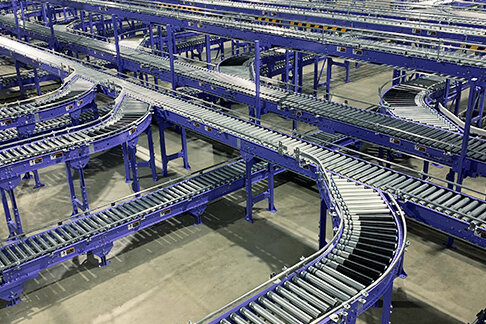
Toyo Kanetsu’s proprietary Ecoloveyor® is utilized for conveyance between the main components. By driving only the sections where cases are present, the system reduces power consumption while achieving highly precise accumulation control. In addition, by adopting a narrow roller pitch damaged to cases is minimized and the risk of carbonated beverage breakage is reduced.
Frozen products are received on pallets and stored in a Pallet ASRS operating at –25°C, with capacity for up to 2,016 pallets. When cases are required for shipment, the relevant pallet is automatically retrieved, necessary cases are picked, labeled, and conveyed to the frozen sortation line. After loading and inspection, products are shipped together with chilled items.
The simplified line configuration enables labor savings and high operational efficiency with minimal handling.

Future OutlookMoving Toward Optimized Logistics to Realize a ¥500 Billion Yen Vision
Future Outlook
Moving Toward Optimized Logistics to Realize a ¥500 Billion Yen Vision
Through seamless integration of systems, the Sakaide Logistics Center has significantly improved productivity. It not only enhances logistics efficiency within Shikoku but also supports accelerated regional store expansion.
Halows aims to deliver safe, secure, and affordable products through a stable supply system while building an optimized logistics infrastructure.
In support of Halows’ long-term vision of achieving ¥500 billion in sales across Western Japan, Toyo Kanetsu will continue leveraging its comprehensive engineering capabilities and technical expertise to support business growth.
*This article reflects information as of March 2025.
Products and Services Introduced